
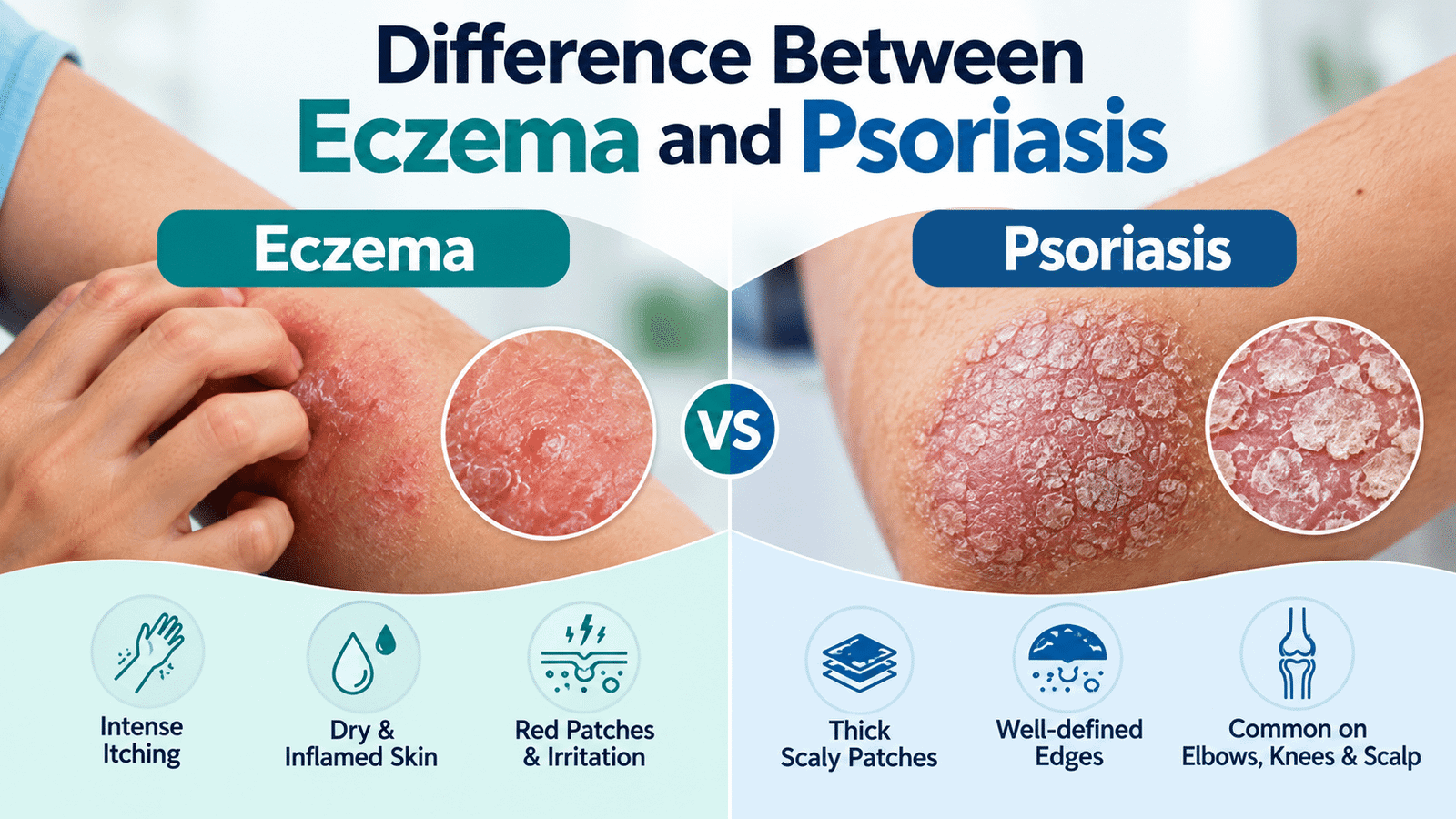
Difference Between Eczema and Psoriasis: Symptoms, Causes and Treatment
A dry, itchy patch of skin can be frustrating, especially when it keeps returning. You may wonder whether it is eczema or psoriasis. Both are common inflammatory skin conditions, but they differ in how they develop, how they look and how they are treated.
Eczema often causes intense itching, dryness and irritated skin. Psoriasis commonly produces thicker, raised patches with clearly defined edges and visible scales. However, these conditions can look similar, and appearance alone cannot always tell them apart.
This guide explains the difference between eczema and psoriasis, their symptoms, common triggers, treatment options and when to consult a dermatologist.
Eczema vs. Psoriasis: What Is the Difference?
The main difference is the pattern of skin inflammation and the way the rash typically appears. Eczema, particularly atopic dermatitis, often causes severe itching and a dry, irritated rash. Plaque psoriasis often causes thicker patches of skin covered with dry scales.
| Feature | Eczema | Psoriasis |
|---|---|---|
| Typical appearance | Dry, inflamed, irritated or sometimes oozing skin | Raised, thick patches with visible scaling |
| Itching | Often intense and may disturb sleep | Can itch, burn, sting or feel sore |
| Patch borders | May be less clearly defined | Often sharply defined |
| Common locations | Skin folds, hands, face, neck and other areas | Elbows, knees, scalp and lower back |
| Skin texture | Dry, cracked or thickened after repeated scratching | Thickened plaques with dry scales |
| Common triggers | Irritants, fragrances, dry weather and individual allergens | Infections, skin injury, stress and certain medicines |
| Long-term pattern | Flare-ups may come and go | Flare-ups may come and go |
These are typical patterns, not strict rules. Both conditions can affect different parts of the body and may appear differently across skin tones. A person can also have both conditions.
What Is Eczema?
Eczema is a general term for a group of conditions that cause dry, irritated and inflamed skin. Atopic dermatitis is the most common type. It can begin in childhood, but adults can develop it too.
In atopic dermatitis, the skin barrier does not protect the skin as effectively as it should. This allows moisture to escape and makes the skin more sensitive to irritants and other triggers.
Common symptoms of eczema
- Intense itching that may become worse at night.
- Dry, rough or flaky skin.
- Inflamed patches that may look red, purple, brown or grey, depending on skin tone.
- Small bumps or blisters that may ooze or form crusts.
- Cracked skin, scratch marks or soreness.
- Thickened skin after repeated scratching.
Where does eczema usually appear?
Eczema may develop on the hands, face, neck, wrists, ankles and in the folds of the elbows or knees. In babies and young children, it often affects the cheeks and other areas of the face. The location varies with age and the type of eczema.
Eczema is not contagious. It cannot be spread through touching, sharing a room or ordinary personal contact.
What Is Psoriasis?
Psoriasis is a long-term inflammatory condition associated with immune-system activity that speeds up the production of skin cells. New skin cells build up faster than the skin can shed them, leading to thickened patches known as plaques.
Plaque psoriasis is the most common type. Psoriasis can also affect the scalp, nails, palms, soles and other parts of the body. Some people develop psoriatic arthritis, which causes joint pain, swelling or stiffness.
Common symptoms of psoriasis
- Raised, thick patches of skin with clearly defined edges.
- Dry, flaky scales that may look silvery or whitish.
- Itching, burning, soreness or skin cracking.
- Changes in nail thickness, colour or surface, including small pits.
- Scalp scaling or patches around the hairline.
- Joint pain or stiffness in people who develop psoriatic arthritis.
Where does psoriasis usually appear?
Psoriasis commonly affects the elbows, knees, scalp and lower back. However, it can appear almost anywhere, including the nails and skin folds. The colour of the patches and scales can vary depending on a person’s skin tone.
Psoriasis is not contagious. It does not spread from one person to another through physical contact.
How to Tell Eczema and Psoriasis Apart
1. Look at the appearance of the rash
Eczema often looks like dry, irritated skin with an inflamed rash. In more severe flare-ups, the skin may ooze, crust or crack. Psoriasis more commonly forms raised, thick plaques with noticeable scales and clearer borders.
2. Consider how the skin feels
Eczema often causes intense itching that leads to scratching and disturbed sleep. Psoriasis can also itch, but some people mainly notice burning, soreness, tightness or cracking.
3. Notice where the patches appear
Eczema commonly affects skin folds, the hands and the face. Psoriasis often affects the elbows, knees, scalp and lower back. These patterns overlap, so the location alone cannot confirm which condition you have.
4. Check for other symptoms
A history of eczema, asthma or hay fever may help a clinician assess the possibility of atopic dermatitis. Thickened nails, scalp plaques or persistent joint stiffness may raise suspicion of psoriasis. These clues are useful but are not enough to make a diagnosis.
5. Remember that both conditions can overlap
Some people have features of both eczema and psoriasis. Other conditions, such as fungal infections or contact dermatitis, can also cause scaly rashes. If a rash persists or keeps returning, professional assessment is more useful than repeatedly changing skin creams.
What Causes Eczema and Psoriasis?
Causes and triggers of eczema
Eczema can involve a combination of skin-barrier changes, immune activity, inherited factors and environmental triggers. The cause differs by eczema type.
Common triggers for some people include:
- Fragranced soaps, cosmetics and detergents.
- Hot showers, sweating or very dry weather.
- Rough fabrics and other skin irritants.
- Stress and certain individual allergens.
- Frequent washing or exposure to cleaning products.
Triggers vary from person to person. Not every person with eczema has an allergy, and broad food restrictions are not recommended without a clear medical reason.
Causes and triggers of psoriasis
Psoriasis is related to an abnormal immune response that speeds up skin-cell growth. Genetics can contribute, although not everyone with psoriasis has a family history of the condition.
Possible flare-up triggers include:
- Infections, including some throat infections.
- Skin injuries, cuts or severe sunburn.
- Stress.
- Smoking and heavy alcohol use.
- Some medicines, depending on the individual.
Do not stop a prescribed medicine because you suspect it is causing a flare-up. Speak with your clinician about any possible connection.
How Are Eczema and Psoriasis Diagnosed?
A dermatologist will usually examine the affected skin and ask questions about your symptoms, medical history, family history and possible triggers. They may also examine your scalp and nails.
In many cases, the clinical examination is enough to make a diagnosis. However, further testing may be needed if the rash is unusual or another condition is suspected.
Tests that may be recommended
- Skin examination: Helps assess the pattern, texture and distribution of the rash.
- Skin scraping or other sample: May help check for a fungal infection or another cause.
- Patch testing: May be useful when allergic contact dermatitis is suspected.
- Skin biopsy: A small sample may occasionally be examined when the diagnosis is unclear.
You can help your doctor by noting when the rash started, what makes it worse, which treatments you have tried and whether symptoms come and go. Photographs taken during a flare-up may also be useful.
Treatment for Eczema and Psoriasis
Eczema and psoriasis can usually be managed with an appropriate treatment plan. The right option depends on the diagnosis, the affected area, symptom severity, age and other medical conditions. Treatments that help one condition may not work for the other.
How is eczema treated?
Treatment may include:
- Regular use of fragrance-free moisturising creams or ointments.
- Gentle skin cleansers and avoidance of known irritants.
- Prescribed topical corticosteroids or other anti-inflammatory creams.
- Prescription medicines or phototherapy for selected moderate-to-severe cases.
- A personalised plan to reduce scratching and prevent flare-ups.
Moisturising regularly helps support the skin barrier. If the skin is painful, weeping, infected or not improving, seek medical advice rather than relying only on moisturisers.
How is psoriasis treated?
Treatment may include:
- Moisturisers and prescribed topical medicines.
- Medicines that help reduce thick scales, when appropriate.
- Phototherapy under medical supervision.
- Oral or injectable medicines for more extensive or severe disease.
- Assessment and treatment for associated joint symptoms.
Psoriasis treatment is tailored to the individual. Some people need more than one treatment, and the plan may change over time.
Daily Skin Care Tips for Both Conditions
Good skin care can reduce dryness and irritation, although it does not replace treatment when medication is needed.
- Apply a fragrance-free moisturiser regularly, especially after bathing.
- Use lukewarm water and avoid long, hot showers.
- Choose mild cleansers and avoid products that irritate your skin.
- Wear comfortable clothing that does not rub against affected areas.
- Avoid scratching or picking at scales and crusts.
- Track flare-ups and possible triggers in a simple diary.
- Follow your prescribed treatment and attend follow-up appointments.
Do not assume that every itchy rash is eczema or psoriasis. A fungal infection, allergic reaction or another skin condition may need a different treatment.
When Should You See a Dermatologist?
Arrange a medical consultation if a rash lasts for a long time, keeps returning, spreads, affects sleep or does not improve with basic skin care. You should also seek advice if you are unsure which condition you have.
Seek prompt medical care if you notice:
- Increasing pain, warmth, swelling or pus in the affected skin.
- Rapidly spreading redness or other signs of a possible infection.
- Fever alongside a worsening skin rash.
- New joint swelling, pain or persistent morning stiffness if psoriasis is possible.
- A sudden, widespread rash with blisters or pus-filled bumps.
A rapidly worsening rash with fever or widespread blistering requires urgent assessment. Severe illness or breathing difficulty is an emergency.
Frequently Asked Questions
1. Is eczema the same as psoriasis?
No. Eczema is a group of conditions that cause inflamed, itchy skin. Psoriasis is a separate inflammatory condition in which skin cells build up quickly, often forming thick, scaly patches.
2. Which is more itchy, eczema or psoriasis?
Eczema often causes intense itching, which may disturb sleep. Psoriasis can also itch and may cause burning, soreness or cracking. The severity differs from person to person.
3. Can eczema turn into psoriasis?
Eczema does not simply turn into psoriasis. They are different conditions, although their symptoms can overlap and a person may have both.
4. Are eczema and psoriasis contagious?
No. Neither eczema nor psoriasis is contagious. They do not spread through touching or ordinary contact with another person. However, some infections that resemble a skin rash can be contagious.
5. Can eczema and psoriasis be cured permanently?
Both conditions can often be controlled, but neither has a guaranteed permanent cure. Symptoms may improve and flare up again. Ongoing treatment may help keep the skin comfortable and reduce flare-ups.
6. Can both conditions affect the scalp?
Yes. Eczema and psoriasis can both affect the scalp. Psoriasis often causes well-defined plaques and scaling, while scalp eczema may cause itching and irritated skin. A dermatologist can help distinguish them.
7. Can children develop eczema or psoriasis?
Yes. Eczema is common in children, but psoriasis can also occur in childhood. Persistent, painful or unexplained rashes in children should be assessed by a qualified healthcare professional.
8. Which doctor treats eczema and psoriasis?
A dermatologist specialises in skin conditions and can diagnose both eczema and psoriasis, recommend suitable treatment and arrange further tests if necessary.
Conclusion: Know the Difference Between Eczema and Psoriasis
Eczema and psoriasis can both cause dry, itchy and irritated skin, but they are different conditions. Eczema often causes intense itching and inflamed skin, while psoriasis commonly produces thicker, well-defined scaly patches. Their symptoms can overlap, so it is not always possible to identify the condition by appearance.
If your rash persists, repeatedly returns or affects your daily life, consult a dermatologist. An accurate diagnosis helps you choose the right treatment and avoid products that may make the condition worse.
Disclaimer
This article is for general educational purposes only and is not a substitute for professional medical advice, diagnosis or treatment. Seek advice from a qualified healthcare professional about your individual symptoms.

